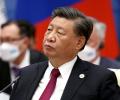
Xi Jinping's recent actions in South Asia have amply demonstrated the disastrous impact of China's embrace, observes Jayadeva Ranade, the retired senior RA&W officer and China expert.

'Why assail the Tibetan leader at a time when many in China realise that the Buddhist monk is the best bet if Beijing is seriously trying to find a solution to the Tibetan issue?' asks Claude Arpi.

China's ruling Communist Party has cracked down on Tibetans who planned to attend the Kalachakra Puja in Bodh Gaya. But the Tibetan people have dared the Communists by listening to the Dalai Lama's sermons on the Internet and sharing videos on social media.

The Steve Smith led Australian cricket team, on Friday, sought the blessings of Tibetan spiritual guru, the Dalai Lama, at his McLeod Ganj monastery in Dharamsala.
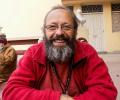
The Dalai Lama headed Kalachakra Puja in Bodh Gaya has drawn devotees from 92 countries.

"The government has pitched in 15,000 security people for a ridiculous torch, which is not even worth Rs 2. Because of the security, the torch has lost all value."

'Information about the Dalai Lama's heath is normally not shared with the public. Its release on this occasion implicitly underscores the message that the window of opportunity for Beijing to recommence the dialogue with the Dalai Lama -- an advocate of non-violence -- to resolve the contentious Tibetan issue is limited.' says Jayadeva Ranade.

US Secretary of State Mike Pompeo on Wednesday named Robert Destro, assistant secretary of state for democracy, human rights and labour, as the special coordinator for Tibetan issues. Destro will focus on advancing dialogue between the Communist-run government in Beijing and the Dalai Lama, protecting the distinct religious cultural and linguistic identity of Tibetans, improving respect for their human rights and much, much more, Pompeo said.
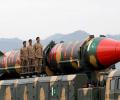
After Donald Trump became president of the United States, he unleashed economic weaponisation, upsetting the old world order, leading to much unrest. If that wasn't all, the threat of an imminent nuclear war was issued by the US, Russia, China, North Korea and Pakistan. In today's fractious times, Dr Paulos Mar Gregorios would have made a dent, notes His Holiness Baselios Marthoma Mathews III.
The rumblings from the Tibetan areas of China continue. The more the Chinese suppress, the more the Tibetans protest. The more the Chinese demonise the Dalai Lama, the more the Tibetans respect him.
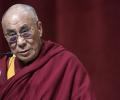
China is worried about the situation post the Dalai Lama and that his reincarnation could surface in Arunchal Pradesh, a region it claims as its own, but which is part of the Indian Republic, says former RA&W Additional Secretary Jayadeva Ranade.

In a statement, the BJP MP of Aarunachal East constituency said communities living beyond the McMahon Line share "deep civilisational roots with Bharat", and it's time for India to reclaim the regions "that are rightfully part of our country".
The United States on Thursday asked China to have substantive talks with the representatives of the Dalai Lama, the Tibetan spiritual leader, without any "pre condition", and called on the Chinese leadership to permit Tibetans to express their grievances freely.

Glimpses from around the world that will make you smile and cry.
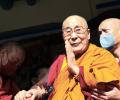
This past week, His Holiness has been in Leh, the capital of Ladakh, the Union Territory where Indian and Chinese soldiers have been in a standoff for two years, since April 2020.

Harvard scholar Lobsang Sangay was on Monday sworn in as the new prime minister of the Tibetan government-in-exile, succeeding the Dalai Lama as the movement's political leader.

'Many senior Bangladeshis feel Bangladesh will fall into anarchy if the Jamaat becomes an important part of a future government or has disproportionate influence in the government.'
The Chinese embassy, in a letter to some of the members of the All-Party Indian Parliamentary Forum for Tibet, expressed concern over their attendance at the event and asked them to refrain from providing support to Tibetan forces.
The next round of talks between envoys of Tibetan spiritual leader Dalai Lama and China, scheduled for June 11, might be postponed because of Beijing's preoccupation with relief efforts for earthquake victims, an aide to the Lama said on Wednesday."China has expressed difficulties in holding talks on June 11 because of the massive earthquake in that country," Tenzing Takhla, secretary to the Dalai Lama, told PTI.
China will step up its control on the management of the numerous Buddhist monasteries in Tibet and its prefectures in the wake of recurring self-immolations by monks, which it alleges are instigated by the Dalai Lama. Senior officials of Tibet Autonomous Region have pledged stepped-up efforts to strengthen the management of monasteries in the fight against the Dalai Lama group, official new agency Xinhua reported.

Statements emanating from the recent Chinese Communist party congress suggest potentially increasing pressure on India with regard to the Dalai Lama and the Central Tibetan Administration in Dharamsala, notes former RAW officer Jayadeva Ranade.
The logical next step for a nation promoting democracy in North Africa or the Middle East would have been to invite the 'elected' leader of the Tibetan diaspora along with the Dalai Lama. But no, Washington prefers to receive the Dalai Lama and ignore Dr Lobsang Sangay, the new 'elected' Kalon Tripa. It is more convenient to receive a 'religious' leader, says Claude Arpi
Ogyen Trinley Dorje hopes to get a university education, but will the government allow it? Anand Sankar wonders.
On March 20, Tibetans voted to elect a new prime minister of the government-in-exile headquartered at Dharamshala. This contest assumed significance as the Dalai Lama stuck to his decision of quitting as the political head of the community. Awaiting Tibet's verdict, Harvard law scholar Dr Lobsang Sangay, the frontrunner in contest speaks about the Dalai Lama, the threat from China and how India's World Cup victory has given hope to the Tibetan cause.
The Chinese side is said to have called off the 15th round of the talks between Special Representatives (SR) of both the sides after India refused to accept their demand that the congregation which was to be addressed by the Tibetan spiritual leader be called off.

'China is concerned about its impact within Tibet.'
Claude Arpi travelled to Dharamsala to record the newly elected Tibetan prime minister's views on the election campaign, his objectives, his government's relation with China and the changes he would like to bring about in Tibetan society. Dr Lobsang Sangay candidly answered all the questions put forth to him
Dr Lobsang Sangay, who was elected Kalon Tripa (prime minister) of the Tibetan government in exile on April 26, speaks about changes to the Tibetan charter, the new role of the Dalai Lama and the Tibetan administration's relations with China.

'Tibet remains a prickly issue between the giant Asian nations. China still claims more than 80,000 sq kilometres of Indian territory in the Northeast. Why? Just because Beijing refuses to acknowledge the McMahon line which separates India and Tibet, and this, simply because the 1914 Agreement delineating the border was signed by the then government of independent Tibet with India's then foreign secretary (Sir Henry McMahon),' says Claude Arpi.
China has said that its doors are open for talks with Tibetan spiritual leader, the Dalai Lama, but reiterated that no concessions would be made on issues concerning national sovereignty.

The United States has thanked India for extending hospitality to Tibetan spiritual leader, the Dalai Lama, a comment and a situation that isn't going to please China, which views the latter as a renegade and a splitist.

Director Martin Scorsese and journalist Pico Iyer discuss Tibetan Buddhism.
US President George W Bush has urged China to hold substantive talks with the Dalai Lama's representatives to address the tibetan people's problems.
69-year-old Samdhong Rinpoche, who heads the administration of the Tibetan Diaspora, speaks out on the uprising in Lhasa, Chinese rule and India's role.

The official names of the 11 places were released on Sunday by the ministry, which also gave precise coordinates, including two land areas, two residential areas, five mountain peaks and two rivers and listed the category of places' names and their subordinate administrative districts, state-run Global Times reported on Monday.
Officials of the US State Department have been briefing the media about the kind of honours that will be accorded to Dr Singh when he visits Washington. These are meant to show that there has been no change in US policies towards India under the Obama administration. The reality is that on every matter, which is of concern to India, greater attention is being paid to China's sensitivities and concerns.
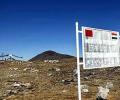
The move was aimed at 'reaffirming China's claim over the state'. China claims the state as 'South Tibet'.
Chinese officials and the Dalai Lama's 'private representatives' agreed to hold another round of 'contact and consultation at an appropriate time', state run Xinhua news agency said after the meeting in the booming southern city of Shenzen. During the meeting, officials Zhu Weiqun and Sitar told the Dalai Lama's envoys that the riots in Lhasa on March 12 had given rise to 'new obstacles' for resuming contacts and consultations with the 'Dalai side', it added.
House Speaker Nancy Pelosi, who along with members of the bipartisan Congressional delegation met the Dalai Lama and the Tibetan Government-in-Exile in India recently, introduced the House Resolution. In a statement on Thursday night, Pelosi said, 'Leaders around the world have called for the Chinese government to take steps to end its crackdown on peaceful Tibetans and enter into a dialogue with his Holiness the Dalai Lama.'
